

A Million Products. Still Fast.
We build commerce platforms that don’t degrade as the catalogue grows — Redis caching and Elasticsearch under the hood, trade and retail pricing in the same store, and the operational side that actually ships the order. Live in Australia, New Zealand, Sri Lanka, and India.
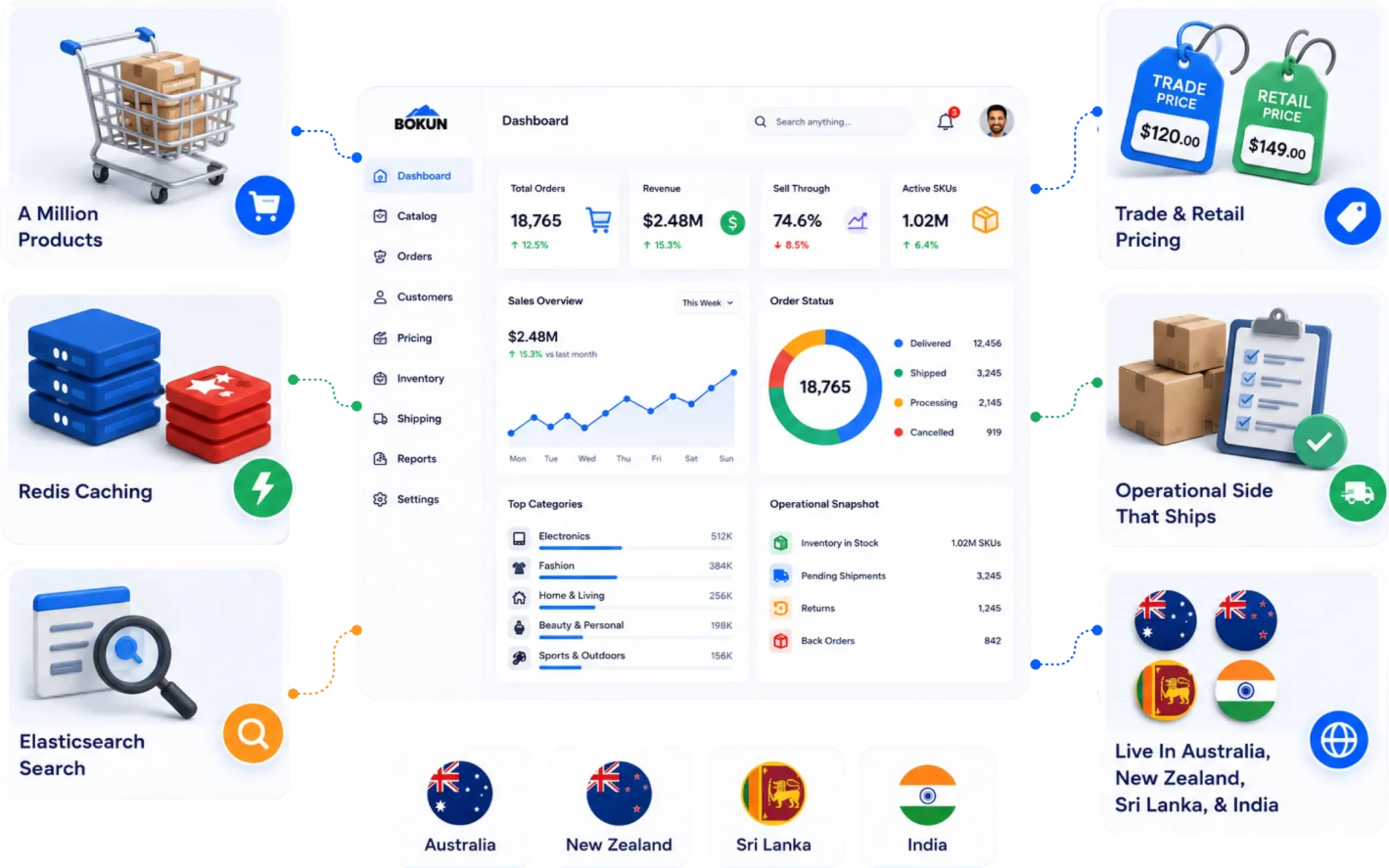

1M+ product catalogues
· Trade & retail pricing · Zoho and delivery-partner integrated

12+ years engineering
Off-the-Shelf Commerce Stops Working at Three Points .
Most platforms are fine until you hit one of these. Then you spend your budget fighting your own software.
Catalogue scale. Everything is fast with 500 products. At 50,000 the search slows, at 500,000 the category pages time out, and faceted filtering becomes unusable. This is an indexing and caching architecture problem, and it can’t be fixed with a plugin.
Two audiences, one store. Trade customers need their own pricing, tax treatment, minimum quantities, and payment terms. Retail customers need none of that. Running both in one platform without building two disconnected stores is where most implementations fall apart.
Operations. The order is the easy part. Splitting a shipment when only half the stock is available, syncing inventory with the system your warehouse actually runs on, handing off to a courier, keeping customer records aligned across systems — that’s where commerce projects quietly consume their budget.
We’ve built past all three, in production.
Featured Builds
Commerce Platforms We’ve Shipped
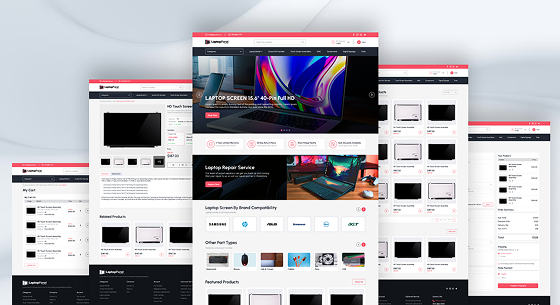
Laptop Commerce
1 Million Products Australia
- A large-scale online store built to handle a million products without the loading speeds catalogues that size usually suffer.
- Search and catalogue architecture. Product search and filtering run on Elasticsearch with Redis caching, which is what keeps browsing and faceted search fast at that volume. Search performance at a million SKUs is an architecture decision made before launch, not an optimisation added later.
- Partial shipment fulfilment. Orders can be split — ship what’s in stock now, fulfil the rest when it arrives — with correct handling of payment, packing, notifications, and the customer’s view of their own order. Most storefronts treat an order as one indivisible unit, which doesn’t survive contact with real inventory.
- Zoho integration. Stock levels, orders, and customer records sync with [[confirm module: Zoho Inventory / Zoho Books / Zoho CRM]], so the commerce platform and the back office hold the same truth instead of drifting apart.
- Delivery partner integration. Courier handoff, label generation, and tracking pushed back to the customer automatically.
- Products Live
- Page Load Times
- Search Response Time
- Orders Processed Monthly

Fairbay
Full-Scale Marketplace Commerce Sri Lanka
- A commerce platform built in the Amazon and Flipkart mould – 5,000 categories and 10,000+ products
- – with web, mobile app, and an admin dashboard built to large-retailer standard rather than storefront-plugin standard.
- Customer side: Campaigns, FairDeals, tiered discounting, and online payments.Admin side: a genuinely deep dashboard covering catalogue, merchandising, promotions, order management, customers, and reporting.
- The hard parts: Deep category navigation that stays usable on mobile at 5,000 categories, promotion and discount logic that composes correctly instead of conflicting, and a single admin surface a real merchandising team can operate daily.
- SKUs Live
- Orders Processed
- App Rating
- Campaign Conversion Uplift
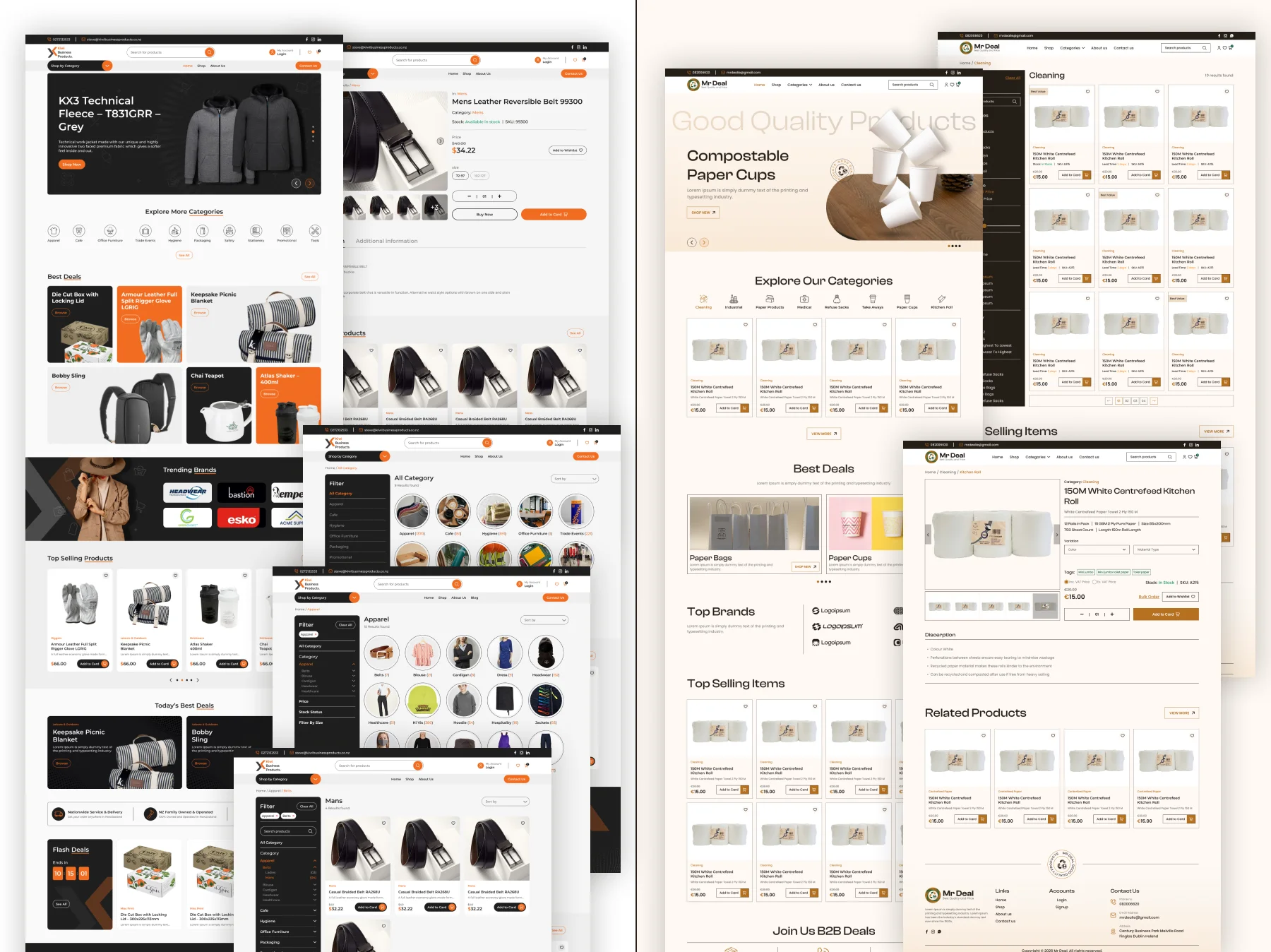
Mr Deal & Kivi Business
Trade and Retail in One Store
- Two platforms built for the same structural problem: Serving trade and retail customers from a single store, each seeing their own pricing and terms.
- Mr Deal (New Zealand) runs trade and retail user types with online payments — separate pricing visibility and account handling on a shared catalogue.
- Kivi Business (Ireland) runs trade and retail alongside large-catalogue handling and supplier product ingestion — bulk CSV import plus API syncing — so third-party supplier catalogues stay current without manual entry.
- The hard parts: Pricing visibility rules that never leak trade rates to retail customers, tax treatment differing by customer type, account approval workflows, and — on Kivi — reliable ingestion of supplier feeds that arrive in inconsistent formats and change without warning.
- Trade Accounts Active
- Retail Vs Trade Revenue Split
- Supplier Catalogues Synced
- SKUs Ingested

Dainy Dubz
Focused Commerce India
- A kids’ clothing store with a deliberately lean admin dashboard, scoped to what a small team will actually use.
- Why it’s on this page: Because not every business needs Fairbay’s dashboard, and building it anyway wastes your money. This is the proof we scope to your stage rather than selling everyone the biggest version.
What We Build
The Systems Behind an Enterprise Store

Catalogue & Search Architecture
Elasticsearch indexing, Redis caching, faceted filtering, autocomplete and typo tolerance, deep category trees, variant and configurable product models, and index strategies that keep results current without constant rebuilds. This is the foundation at scale — get it wrong and no amount of front-end work saves the site.

Trade & Retail Pricing
Customer groups with independent price lists, tiered and quantity-break pricing, tax treatment by customer type, minimum order quantities, credit terms and account limits, approval workflows for trade registration, and strict visibility rules so trade rates never surface to retail.

Order & Fulfilment Operations
Order creation from the admin side, partial and split shipments, backorders and pre-orders, multi-warehouse allocation, returns and RMA handling, courier integration with label generation, and tracking pushed to the customer without anyone sending an email.

Promotions & Campaign Engine
Campaigns, deals, coupon and voucher logic, tiered and conditional discounting, bundles, and stacking rules that resolve predictably. Promotion logic that conflicts with itself is one of the most common sources of revenue leakage in enterprise commerce.

Supplier & Data Ingestion
Bulk CSV import, scheduled API sync, field mapping for inconsistent supplier formats, validation and error reporting, image handling, and update reconciliation – so a supplier changing their feed doesn’t corrupt your catalogue.

Back-Office Integration
Two-way sync with the systems your business already runs – Zoho, ERP, accounting, warehouse management, CRM – so stock, orders, and customer records don’t diverge.
Merchandising & Admin
The dashboard your team lives in: catalogue management, bulk editing, merchandising controls, promotion setup, order operations, customer management, and reporting. Scoped to the size of your team, not to a feature checklist.
Where AI Fits
AI Where It Earns Its Place
Large catalogues are among the best places to apply AI, because the payoff scales with the number of products a customer can’t manually browse.
01
Search Relevance
Semantic search that understands intent, which matters far more at a million SKUs than at a thousand
02
Product Recommendations
Related, complementary, and personalised discovery, the main conversion lever on large catalogues
03
Catalogue Enrichment
Generating descriptions, attributes, and categorisation from supplier feeds, otherwise the biggest manual cost of large-catalogue commerce
04
Dynamic Pricing
Competitive and demand-responsive pricing, with trade tiers respected
05
Demand Forecasting
Stock planning and reorder points from real sales history
06
Fraud Detection
Order screening before fulfilment
07
Automated Support
Order status and returns handled without a ticket
Custom or Off-the-Shelf
When You Shouldn’t Build Custom
Use Shopify or WooCommerce if: Your catalogue is under a few thousand SKUs, your pricing is straightforward, you’re B2C only, and existing apps meet your integration needs. It’ll be cheaper and faster, and you don’t need us.
Consider Magento or a headless platform if: You need enterprise features but your requirements are broadly standard and you have a team to run the platform.
Build custom when: Your catalogue is large enough that performance is an architecture problem, you’re running trade and retail together with real pricing complexity, your fulfilment involves partial shipments or multi-warehouse allocation, or you’re integrating deeply with back-office systems that have no plugin.
All four platforms on this page fell into the third category. The performance audit will tell you which one you’re in – including when the answer is that you don’t need a custom build.
Integrations
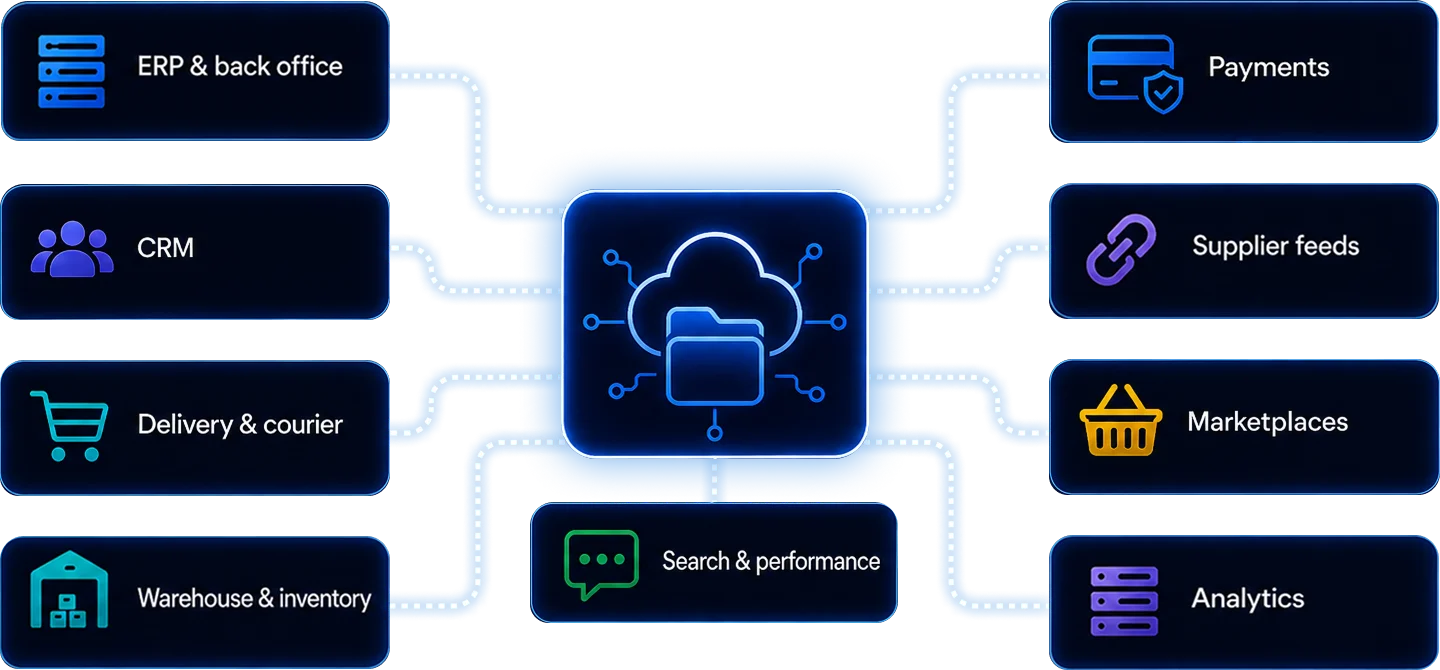
Connected to How Your Business Runs

ERP & back office
Zoho, SAP, NetSuite, Dynamics, QuickBooks, Xero, Tally

CRM
Zoho CRM, Salesforce, HubSpot

Payments
Stripe, Adyen, PayPal, Razorpay, plus regional gateways for AU, NZ, and South Asia

Delivery & courier
Regional carriers with label generation and tracking callbacks

Warehouse & inventory
WMS, multi-warehouse stock allocation, barcode workflows

Search & performance
Elasticsearch, Redis, CDN and image optimisation

Marketplaces
Amazon, eBay, and regional channel feeds

Supplier feeds
CSV, SFTP, and scheduled API sync with field mapping

Analytics
GA4, server-side tracking, custom reporting
Process
How a Commerce Project Runs
01
Commerce Performance Audit
Free, 1 to 2 Weeks We test your current catalogue and search performance, review Core Web Vitals, map your checkout funnel for drop-off, and identify integration gaps. You get a written findings document with a prioritised fix list — and a straight answer on whether you need a custom build at all. Yours to keep either way.
02
Architecture & Data Model
2 to 4 Weeks Catalogue and variant model, search and indexing strategy, pricing and customer-group rules, fulfilment logic, and integration contracts. On a large catalogue these decisions are effectively permanent, which is why they get their own phase.
03
Core Build
10 to 20 Weeks Catalogue and search first, then storefront, checkout, pricing rules, and admin. Driven by catalogue complexity, pricing rules, and integration count — not template count.
04
Data Migration
Products, variants, images, customers, historical orders, and SEO URL mapping. Migration is where large-catalogue projects most often lose weeks, so we scope it as real work rather than a final step.
05
Load & Performance Testing
Tested at your target catalogue size and traffic peak, not at demo scale. Search response, category page load, and checkout under concurrency.
06
Launch & Peak Support
Phased cutover with redirects and rank protection, plus extra coverage through your first sales peak.
Why Infosparkles
Why Teams Bring Us In
01
We’ve built at a million products.
Redis and Elasticsearch, in production, on a live store. Catalogue performance at scale is the thing most agencies have never actually had to solve.
02
We’ve built trade and retail together, twice.
Mr Deal and Kivi Business both run dual-audience pricing on a shared catalogue. It’s a common enterprise requirement and a common implementation failure.
03
We build the operational half.
Partial shipments, multi-warehouse allocation, courier integration, and back-office sync. The storefront is the visible part; operations is where the budget goes.
04
We handle messy supplier data.
CSV and API ingestion with validation and reconciliation, because supplier feeds arrive inconsistent and change without notice.
05
We scope to your stage.
Dainy Dubz got a lean dashboard. Fairbay got a full merchandising suite. We’ll tell you which one you are — including if the answer is Shopify.
06
You own the platform.
Full source, documentation, no licence dependency on us.
Frequently Asked Questions
Yes. Laptop Commerce is built for a million products, with search and filtering on Elasticsearch and Redis caching. Performance at that volume is an architecture decision made before the build, not an optimisation afterwards.
Yes – Mr Deal and Kivi Business both do. Separate price lists per customer group, tax treatment by customer type, quantity breaks, account approval, and strict visibility rules so trade pricing never leaks to retail.
Yes. Laptop Commerce supports partial shipment from a single order, with payment, notifications, and the customer’s order view all handled correctly. Most platforms treat an order as indivisible.
Yes. Kivi Business ingests supplier catalogues via bulk CSV and scheduled API sync, with field mapping, validation, and error reporting for feeds that arrive inconsistently.
Yes, in production – stock, orders, and customer records syncing between the store and Zoho on Laptop Commerce. We also integrate SAP, NetSuite, Dynamics, Xero, and QuickBooks.
Shopify if your catalogue is modest, your pricing is simple, and you’re B2C only. Custom when catalogue scale makes performance architectural, or you have real trade pricing, complex fulfilment, or deep back-office integration. The audit gives you a straight answer, including “you don’t need us.”
Yes. Full URL mapping and redirects, structured data preserved, phased cutover. Rank protection is planned into migration rather than dealt with afterwards.
Typically 4 – 7 months. Catalogue complexity, pricing rules, and integration count drive the timeline – not the number of page templates.
That’s the point of the architecture. Fairbay runs 5,000 categories and 10,000+ products in a mobile app; Laptop Commerce serves a million – product catalogue on the web. Core Web Vitals are a build requirement, not a post – launch project.
You do, on delivery. Full source, documentation, and deployment access.
Find Out What’s Slowing Your Store Down
Book a free commerce performance audit. We’ll test your catalogue and search performance, review Core Web Vitals, map your checkout drop-off, and send you a prioritised fix list — plus a straight answer on whether a custom build is even the right call. Yours to keep, no obligation.